Sustainability in Corporate Housing: What’s Changing, What We Heard at Connect26 and How FACCT Helps You Win Business
As we wrap up Earth Month, I wanted to share a peer-to-peer update as a member of the CHPA Sustainability Task Force—what we’re seeing in sustainable priorities across corporate housing and mobility, a recap of our sustainability session at Connect26 in Austin, and (most importantly) how members can use the Furnished Accommodation Carbon Calculation Tool (FACCT), powered by CHPA, to strengthen RFP responses, client reporting requests and differentiate commercially.
1) Sustainable priorities in our industry: why this is now a supplier-selection issue
Sustainability is not a “nice to have”, check the box exercise in corporate housing—it’s increasingly written into procurement language. Across corporate client RFPs (and RFPs issued by relocation management companies on behalf of those clients), sustainability requirements and reporting expectations are showing up with more frequency and more specificity. For suppliers, that means sustainability has moved from marketing into measurable capability.
One helpful way to frame the ‘why’ is through three supplier-selection signals that show up consistently in sustainable procurement guidance across business services:
- Regulatory readiness: awareness of evolving requirements and the ability to provide credible reporting when clients need it
- Corporate responsibility alignment: practices that demonstrate credibility to clients and their internal/external stakeholders
- Operational resilience: evidence you’re risk-aware, ethical and able to adapt in a fast-changing commercial and compliance environment
2) Connect26 recap: what we heard from buyers, CHPA and housing providers
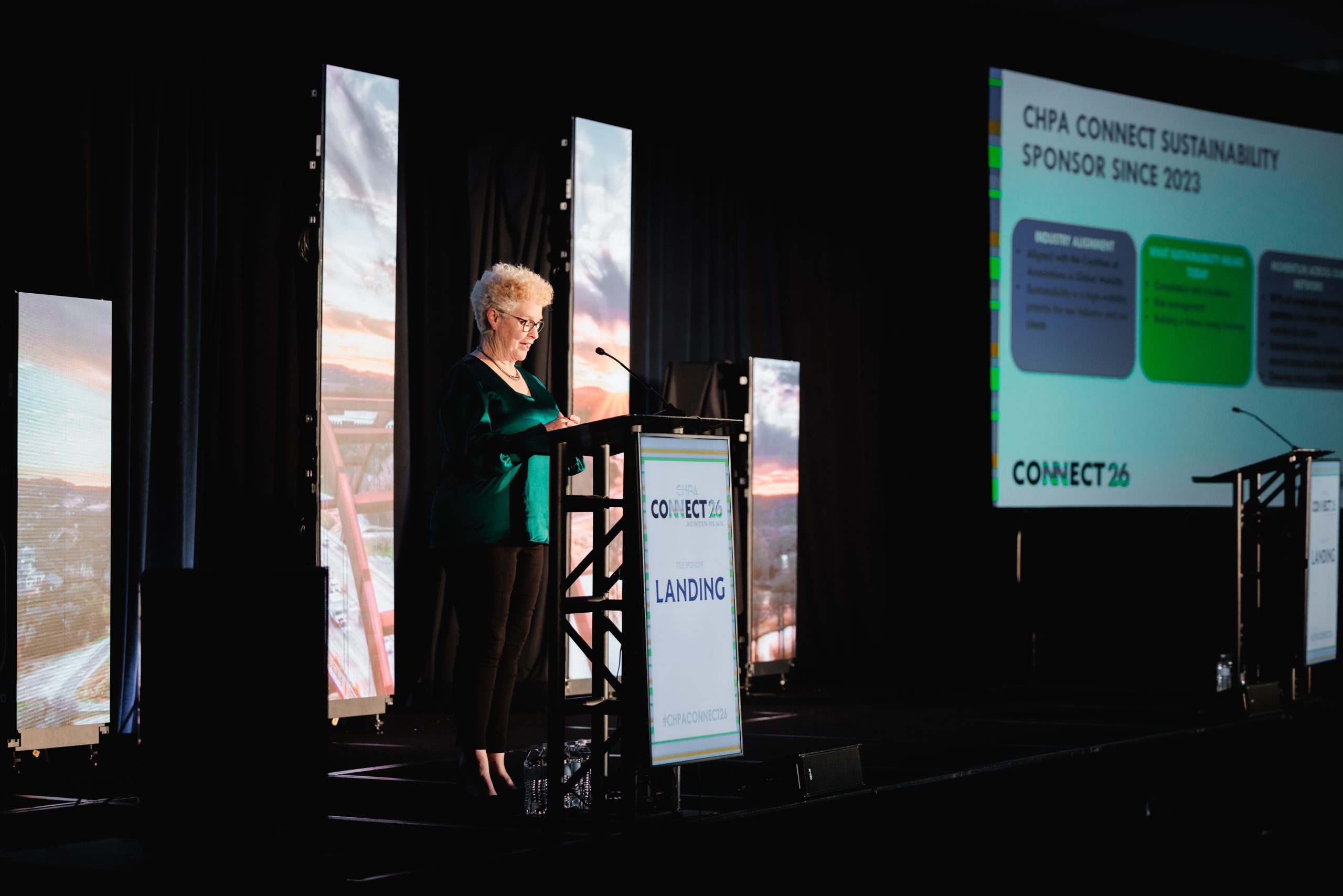
At CHPA Connect26 in Austin, we dug into the real question members ask: Is sustainability actually influencing buyer decisions in corporate housing? The answer from the stage was clear. In a panel discussion moderated by Dwellworks Living with panelists CHPA CEO Nick Estrada, CAE, CMP, Sustainability Task Force Co-Chairs Jo Layton (Founder & CEO, CAP Worldwide) and Debbie Woodley, CCHP (VP, Supply Chain, CWS Corporate Housing), as well as Jackie Charney (Director, Supply Chain, Cartus), we focused on what corporate and RMC buyers expect now—and what they’ll expect next.
Buyer perspective: sustainability expectations are scaling across supply chains
Jackie Charney, who leads corporate housing supply chain at one of the industry’s largest RMCs, grounded the discussion in day-to-day procurement reality. Her message: clients want partners who can scale, but they also want partners who can measure and show progress over time—even when supplier size and maturity varies widely across the supply chain.
Partner selection must align with employer needs, industry requirements and the ability to scale service delivery. Suppliers are expected to define sustainability actions that are realistic, measurable and capable of continuous improvement. Charney also emphasized that supplier management teams are increasingly expected to engage providers directly on sustainable performance —asking how programs are implemented, what data is available and how results are tracked.
She also shared several practical takeaways that will sound familiar to anyone responding to corporate or RMC RFPs right now:
- Sustainability action and measurement requirements continue to appear in the vast majority of client programs
- Global Mobility teams are focusing on eco-friendly transportation and housing as two of the highest-impact areas
- Consistent, comparable data reporting is key to objective assessment of partners
- Cartus supports FACCT and the move toward objective reporting approaches used in other sectors
Connect26 proof-point: a corporate client use case where FACCT influences supplier selection
CHPA created FACCT to give housing suppliers a practical starting point for calculating and reporting emissions associated with a stay in a furnished unit. The immediate value is establishing a baseline: once you can measure, you can answer client questions with confidence, compare performance over time and identify realistic operational changes. In other words, the early ‘win’ is not perfection—it’s participation and credible data.
During the “Get the FACCTs” session, Task Force Co-Chair Jo Layton shared a concrete example of how one corporate client has moved from expectation to action—building sustainability reporting directly into how corporate housing suppliers are evaluated.
- A global bank (approximately $65B in annual revenue) mandated transparent, auditable reporting on environmental performance and unit-level emissions
- The CAP Worldwide partner team issued a supplier RFP requesting FACCT emissions by unit
- Suppliers who participate in FACCT are positioned to earn bookings—because they can answer the reporting requirement
- Emissions and sustainability inputs are incorporated into housing requests and decision workflows
- The client, CAP Worldwide, and CHPA support suppliers through FACCT education and webinars to complete calculations
- Emissions reporting becomes formal criteria in partner evaluation and selection, and may also be visible at the point of booking
This is a compelling use case because it comes from an influential global organization and it shows the direction of travel program management: buyers are asking for unit-level data, not broad statements of intent. The takeaway for members is straightforward—FACCT participation helps you stay eligible, helps you compete and creates the foundation for future investment in sustainable operations as the business case is proven through real bookings.
One member’s perspective: what sustainability looks like in operations (and in RFP responses)
Debbie Woodley, CCHP, VP of Supply Chain at CWS Corporate Housing and Co-Chair of CHPA’s Sustainability Task Force, shared how CWS approached FACCT and why the effort is worth it—even when data gathering feels like “one more thing” on an already full plate.
CWS has been recognized in our industry for customer service, global citizenship and innovation. As a founding FACCT partner, CWS also became an early user of the tool—leading by example and learning what it takes to operationalize the process.
Woodley explained that CWS uploaded its first year of data (2024) and is in the process of uploading 2025 because they want the visibility the data provides. They can proactively share emissions information with clients and include it in RFP responses—positioning CWS as both innovative and socially responsible. These are the exact attributes corporate procurement teams are increasingly looking for when they decide which partners join (or stay in) their supply chain.
Woodley put it simply: “ESG/sustainability programs with clear results increase our relevancy, elevate our status with clients and keep us in the game.” She also emphasized that while FACCT data gathering isn’t effortless, it’s achievable—and that members don’t have to do it alone. Sponsors of the calculator and CHPA itself have offered to help peers get engaged. As she noted, “The point is not ‘good or bad’ emissions. The point is that data is king.”
3) Task Force ownership: where FACCT is headed—and how members can engage now
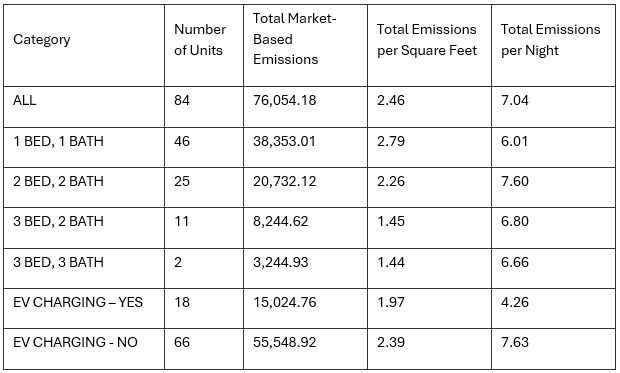
During Connect26, CHPA CEO Nick Estrada, CAE, CMP shared an early look at what initial member data inputs are showing. The dataset is still small, but it proves an important point: unit-level emissions data is trackable, can be analyzed objectively, and can be shared in ways that help buyers compare like with like. That’s a meaningful step away from generic statements and “averages of averages,” and toward credible reporting that stands up in an RFP environment.
Example snapshot (early FACCT dataset): an illustration of how supplier submissions can be summarized by unit category and compared across common metrics.
Following Connect26, the Sustainability Task Force met to align on next steps. The shared view from Nick, Debbie, and Jo: FACCT needs to be at the forefront of our industry’s sustainability conversation because corporate clients increasingly expect it—and members deserve practical support to meet that expectation without reinventing the wheel.
FACCT is also being integrated into emissions reporting discussions across multiple mobility sectors through the Coalition for Associations in Global Mobility. The Coalition’s goal is to speak with one voice to corporate clients—demonstrating the value and impact of mobility support services. Aggregated emissions reporting, backed by consistent methodology, can become a credible proof-point for buyers who are under pressure to report progress to their own stakeholders.
What the Sustainability Task Force owns in 2026 (and what we’re asking members to do)
Our Task Force is a group of 12 member representatives working to make sustainability more practical, more consistent, and more commercially usable for the full CHPA community. Below are the initial priorities we’ve aligned on for 2026. If you only take one thing from this blog, let it be this: more member participation in FACCT strengthens the credibility of the tool—and the market credibility of all participating suppliers.
- Secure a minimum of 25 supplier datasets this calendar year to strengthen benchmarks and buyer confidence
- Activate FACCT founders and early adopters to demonstrate use cases to corporate/RMC buyers and build credibility in reporting
- Position FACCT as an ESG-enabled business tool and compliance/governance resource—not only a carbon calculator
- Support development of an easier, web-based participation experience to reduce friction for suppliers
- Advance API options so agencies and enterprise partners can pull, aggregate and report supplier data efficiently
- Once the dataset is sufficient, publish practical guidance on what “sustainable inventory” can include—so members have clear, achievable next steps
We’ll continue to share updates, training opportunities and member stories as this work progresses. For now, the most valuable step any supplier can take is to start (or continue) building a FACCT dataset—so you can respond confidently when sustainability questions show up in RFPs, client reviews and supply chain scorecards.
Getting started with FACCT: a practical checklist
If you’re new to FACCT, the biggest hurdle is usually just getting organized. Here’s a straightforward way to begin—without waiting for a “perfect” internal sustainability program.
- Assign an owner. Choose one person to coordinate the first submission (operations, procurement, finance, or sustainability—any can work as long as it’s clear who owns the timeline).
- Start with a manageable scope. Pick a representative set of units or a priority market and complete a first pass; expanding your dataset becomes much easier once you’ve learned the process.
- Gather the inputs you already have. Most suppliers have much of the needed information in utility records, property data and operational documentation—even if it isn’t centralized yet.
- Complete your first upload and capture “lessons learned.” Document what was easy, what took time and what you need to streamline before the next cycle.
- Use the output commercially. Add a short, factual statement to RFP responses that you participate in FACCT and can provide unit-level emissions estimates using an industry tool.
- Improve iteratively. Treat year one as baseline, year two as refinement, and year three as optimization—buyers recognize continuous improvement when it’s measurable.
Closing: let’s make sustainability measurable—and commercially useful
- Buyer expectations are clear: sustainability commitments need evidence, not only intent
- FACCT is a practical way to provide unit-level proof and support client reporting requirements
- CHPA and the Sustainability Task Force are focused on training, enablement, and peer support to accelerate adoption
- For suppliers, sustainability is increasingly tied to compliance—and to staying competitive in award decisions
Want help completing your first FACCT submission? Reach out to CHPA and ask to be connected with a FACCT mentor from the Sustainability Task Force or our founding partners. If you’re already participating, consider sharing a short ‘what I wish I knew in year one’ tip with the community—your peer experience is often the fastest way to remove friction for others.