The Real Leverage in Sustainable Housing
Why measurement — not marketing — will decide the next RFP
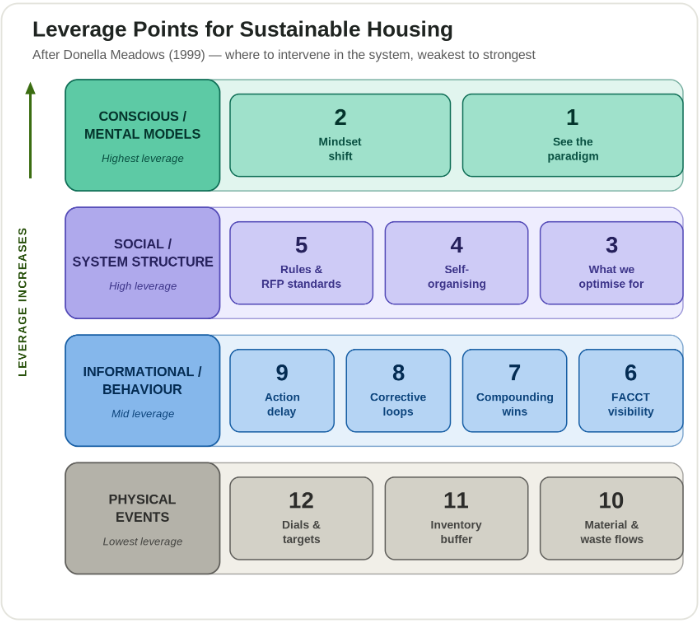
In 1999, the systems thinker Donella Meadows published a now-famous list of leverage points — the places to intervene in a system, ranked from the weakest to the most powerful. Her central insight was an uncomfortable one: we instinctively reach for the easy interventions, the ones that feel productive but barely move the system, while the real power sits higher up, where it is harder to act.
Corporate housing has a sustainability version of this exact problem. Walk any trade-show floor and you will hear about LED bulbs, low-flow fixtures and recycling programs. These are good things worth doing. They are also, in Meadows’ terms, among the lowest-leverage points on the board — the dials and parameters that a system quickly absorbs without changing course. If we want sustainability to actually shift our industry’s trajectory, and to keep us competitive, we have to look further up the ladder.
Here is why this matters now, not someday. Sustainability has quietly moved from marketing copy into procurement language. Across corporate RFPs, and the RFPs that relocation management companies issue on their clients’ behalf, emissions reporting and sustainability requirements are appearing with more frequency and more specificity. At CHPA’s Connect26 gathering, a supply-chain leader from one of the industry’s largest RMCs put it plainly: clients want partners who can measure and show progress over time. One global bank now requests unit-level emissions data in its supplier RFP and folds that data directly into how housing partners are evaluated and selected. Read that again: emissions data is becoming a selection criterion. Suppliers who can answer it stay eligible. Suppliers who cannot quietly fall off the scorecard. This is no longer an environmental conversation happening alongside the business — increasingly, it is the business.
Where the leverage actually is
So where should our energy go? If the tier-one fixes are the weakest levers, three points higher up carry far more weight.
First, information flow — who can see the data. This is precisely what the Furnished Accommodation Carbon Calculation Tool (FACCT) does. By giving providers a consistent way to calculate and report unit-level emissions, FACCT turns vague intentions into comparable numbers. Making performance visible is one of the highest-leverage moves any system can make — and it is one our industry already has in hand.
Second, the goal of the system — what we optimize for. For decades, corporate housing has optimized for cost and speed of placement. The opportunity now is to add a third axis: carbon. Redefining what we mean by “quality housing” to include its environmental footprint changes what every downstream decision quietly points toward.
Third, and most powerful, mindset — As long as sustainability is treated as a nice-to-have checkbox, it will be underfunded and easy to cut. The moment it is understood as a core requirement of staying competitive, everything else follows. As one Task Force co-chair likes to say: the point is not good or bad emissions. The point is that data is king.
The operator’s reality: you don’t need a sustainability department
If all of this sounds like it requires a corporate sustainability team, here is the good news — it does not. That is the part I most want fellow operators to hear. You do not need a perfect program to participate. You need a baseline. Most of what FACCT asks for already exists — in utility records, property data and the operational documents most providers already keep. The work is less about generating new data and more about centralizing what you have. Pick one representative market or a handful of typical units, complete a first pass and learn the process. Year one is a baseline. Year two is refinement. Year three is optimization. Buyers recognize continuous improvement when it is measurable, and they reward it.
The early win is not a flawless emissions figure. It is participation — and the credibility that comes with being able to answer the question at all. For a small or mid-size provider, that credibility is a genuine competitive equalizer: you do not have to be the largest supplier in the room to be the one who shows up with real data.
The leverage compounds when we act together
For the industry as a whole, the effect multiplies. Every provider who contributes a dataset strengthens the shared benchmarks, which strengthens buyer confidence, which strengthens the case for the tool — a reinforcing loop that lifts everyone who participates. The more of us who engage, the more credible our collective number becomes when the sector speaks to corporate clients with one voice.
So consider this an invitation. If you have been waiting for the perfect moment or the perfect program, stop waiting. Assign one person, gather the data you already have and start a FACCT dataset. Bring your questions to the Task Force — the friction you encounter is exactly the feedback that makes the tool better for the next provider, and it is how we keep strengthening both the approach and the structure behind it.
We reach for the easy levers because they are within arm’s reach. But the ones that will define the next decade of corporate housing sit higher up: measure what matters, change what we optimize for, and treat sustainability as the competitive requirement it has already become. That is where the leverage is. Let’s pull there together.