Procurement, Travel and Global Mobility Convergence
How Decision-Making Authority Is Evolving and What Furnished Apartment Providers Must Do to Stay Aligned
For decades, corporate housing providers primarily built relationships with relocation managers and HR departments, working directly with mobility teams to support employee relocations, project assignments and executive moves into temporary furnished apartments.
That model has changed significantly. Decision-making for extended-stay housing is increasingly influenced by procurement and finance rather than travel management and mobility. Together within integrated workforce mobility programs focused on cost control, compliance and traveler safety.
For furnished apartment providers, especially firms under $20 million in revenue, have experienced both a challenge and an opportunity in this ever-changing environment. Those who understand how these functions intersect will be best positioned to secure corporate contracts and strengthen long-term client relationships.
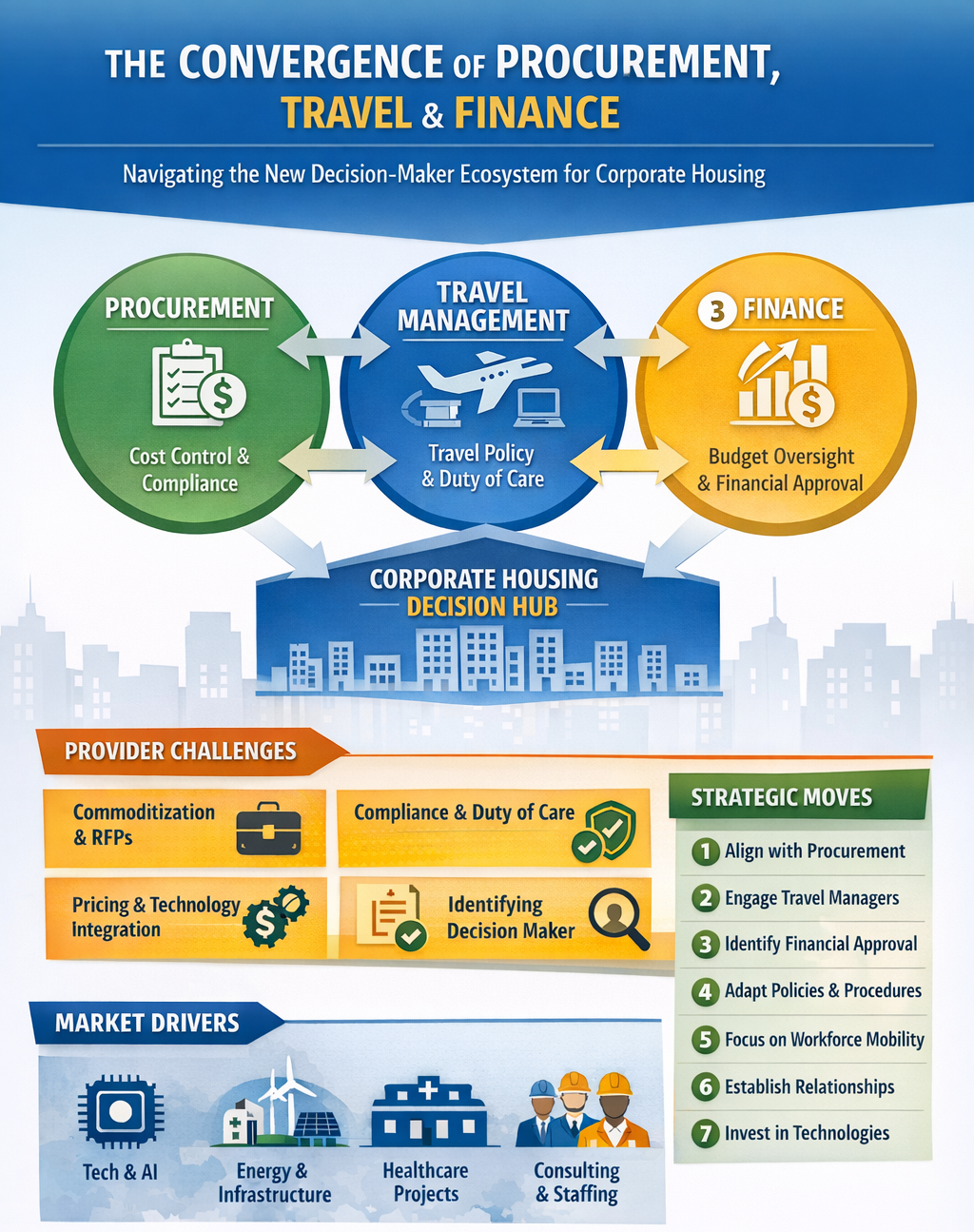
The Convergence of Procurement, Travel, Mobility and Finance
Companies now move employees less for traditional relocations and more for project assignments, consulting engagements, healthcare staffing, infrastructure projects and technology deployments, placing temporary housing within broader corporate travel and procurement strategies.
At the same time, many large and mid-sized organizations across North America have reduced staffing in travel management, global mobility and HR as part of broader efforts to streamline operations and centralize administrative functions. Over the past decade accelerated by the pandemic, companies have consolidated roles, outsourced relocation services and shifted responsibility for travel and assignment-related spending to procurement and finance teams. As a result, decisions around long-term travel and temporary housing are increasingly influenced, and often approved, by finance leadership focused on cost control, vendor consolidation and measurable return on spend. While travel and mobility professionals still guide policy and logistics, final approval for extended-stay housing providers and vendor contracts is frequently determined through finance-led sourcing strategies.
Who’s in Charge?
Procurement becomes more deeply involved in corporate travel and supplier sourcing; decision-making authority is often distributed across multiple departments. While this structure is designed to improve cost control and compliance, it can make it significantly more difficult for furnished apartment providers to identify the true decision-maker responsible for long-term lodging initiatives. In many organizations, housing needs may originate within a business unit or mobility team, but vendor selection and pricing approval are increasingly managed through procurement or finance-led sourcing processes. As a result, providers must navigate a more complex internal landscape to find the individual or group ultimately responsible for approving extended-stay housing solutions.
Key Challenges Facing Providers Today
- Procurement-Driven Commoditization
Procurement often view temporary housing as a lodging category rather than a specialized housing solution. This can lead to commoditized bidding processes where providers are compared primarily on nightly price rather than value or service differentiation.
- The Evolving Business Travel Landscape
Business travel is changing rapidly. According to GBTA forecasts, North American business travel spending is expected to grow steadily through the late 2020s, but travel patterns are shifting toward longer project-based assignments and hybrid travel models.
- Compliance and Duty of Care
Corporate responsibility for traveler safety has expanded significantly in recent years. Employers must now demonstrate duty of care obligations, ensuring employees are housed in safe, compliant accommodations with clear communication protocols. Providers must increasingly demonstrate property standards, safety protocols and reliable reporting capabilities.
- Complex RFP Processes
Large corporations are issuing more formal RFPs for extended stay housing, often combining hotel, serviced apartment, and furnished housing vendors into the same sourcing process. For local providers, navigating procurement frameworks, compliance documentation and pricing structures can be resource intensive.
- Pricing Transparency Expectations
Corporate buyers increasingly expect clear pricing structures, standardized rate formats and reporting visibility. This trend is driven by procurement analytics tools that track lodging spend across travel programs. Providers that cannot easily communicate value and pricing consistency may struggle to compete in these environments.
- Technology and Platform Disruption
Corporate travel programs increasingly rely on integrated booking platforms, travel management systems, and data analytics tools to manage vendor relationships and traveler safety. At the same time, new technologies including AI-driven booking automation and supplier marketplaces are beginning to influence how extended stay accommodations are sourced.
Market Drivers Behind Extended-Stay Demand
Despite these challenges, demand for furnished apartments across North America will see demand from several major economic drivers in workforce mobility:
- Technology and AI infrastructure
- Semiconductor and advanced manufacturing
- Renewable energy and utilities
- Healthcare staffing and medical travel
- Construction and infrastructure development
- Consulting and project-based professional services
Major infrastructure investments across the United States and Canada combined with reshoring of manufacturing and technology expansion are creating large populations of project-based workers who require temporary housing for months at a time. These trends reinforce the value proposition of furnished apartments as a cost-effective and productive alternative to hotels.
Looking Ahead
The convergence of procurement, travel, and global mobility represents one of the most significant shifts the corporate housing industry has seen in decades. Providers across North America must now understand how corporate decisions are influenced by procurement, finance, and travel management. As sourcing becomes more centralized, furnished apartment providers are increasingly engaging with broader enterprise travel and vendor management frameworks. Despite these changes, the fundamental need for comfortable, reliable housing for professionals on assignment remains unchanged. Companies that adapt to this evolving decision landscape will be best positioned for continued growth.
Sources
- Global Business Travel Association (GBTA) Business Travel Outlook
- Deloitte Global Mobility Trends Survey
- U.S. Bureau of Labor Statistics Workforce Mobility Data
- Corporate Housing Providers Association (CHPA) Industry Reports
- PwC Workforce of the Future Mobility Research
About Revalant Consulting
Revalant Consulting is a strategic advisory firm specializing in the corporate housing, furnished apartment, and extended-stay lodging industries. Founded by James Higgins, the firm provides executive-level consulting, business development strategy, and market intelligence to operators, investors and service providers across North America. Revalant works closely with corporate housing companies to help them navigate evolving procurement structures, corporate travel programs and workforce mobility trends while strengthening sales strategies, operational performance and client engagement. Through research, advisory services and industry thought leadership, Revalant Consulting supports organizations seeking to better position their businesses within the rapidly changing landscape of corporate travel and temporary housing. www.revalantco.com